Part 3. Whispers from Oaxaca: The West 'Discovers' Sacred Mushrooms
Important Disclaimer: This series looks at the history and culture surrounding psychedelic substances. The info here is only for education and isn't medical advice or an endorsement of any practice. Always talk to qualified professionals about health stuff. Compassion Retreats encourages safe, legal, and intentional exploration in proper settings.
For hundreds of years after the Conquest, the use of psychoactive mushrooms by indigenous people stayed mostly hidden from the outside world. You'd occasionally hear about it in Inquisition records, but it wasn't part of mainstream Western life. That all changed pretty dramatically in the mid-20th century, mainly because of one man's intense curiosity: Robert Gordon Wasson.

Wasson, who was a vice president at J.P. Morgan & Co., was an amateur mycologist. His fascination with fungi really got going thanks to his Russian-born wife, Valentina Pavlovna Wasson. She was totally comfortable with wild mushrooms, which sharply contrasted with his own Anglo-Saxon "mycophobia" (fear of mushrooms). This led them to develop theories about how culture influences attitudes toward fungi. Intrigued by old historical accounts and tips from earlier researchers like Richard Evans Schultes (who identified teonanácatl back in the 1930s), Wasson got convinced that ancient mushroom rituals were still going on in remote Mexico.
His search eventually took him, over several trips, to the Sierra Mazateca mountains in Oaxaca. In June 1955, in the village of Huautla de Jiménez, Wasson and his photographer, Allan Richardson, convinced the local Mazatec healer (curandera), María Sabina, to let them take part in a sacred mushroom ceremony, or velada. Wasson later claimed, somewhat controversially, that they were the "first white men in recorded history to eat the divine mushrooms." He supposedly built Sabina's trust by pretending he was worried about his son's health.
The velada, as Wasson and later ethnographers described it, was a night ritual steeped in tradition, even though it often mixed in Catholic elements. Led by the chjota chjine (shaman), it involved careful preparation and eating of fresh psilocybin mushrooms (ndi xijtho, which means "little ones that sprout"). These were usually eaten in pairs, representing male and female principles. The ceremony unfolded with Mazatec chants and prayers (sometimes mentioning Catholic saints or the Virgin Mary) and using ritual items like candles, copal incense, tobacco, and flowers, all set up on a ritual "table." The purpose was usually healing, divination (looking for answers or lost things), or connecting with the sacred world and ancestral spirits. The shaman would enter an ecstatic trance, acting like a bridge for the mushroom's wisdom or negotiating with spiritual beings (chikones, nature guardians).

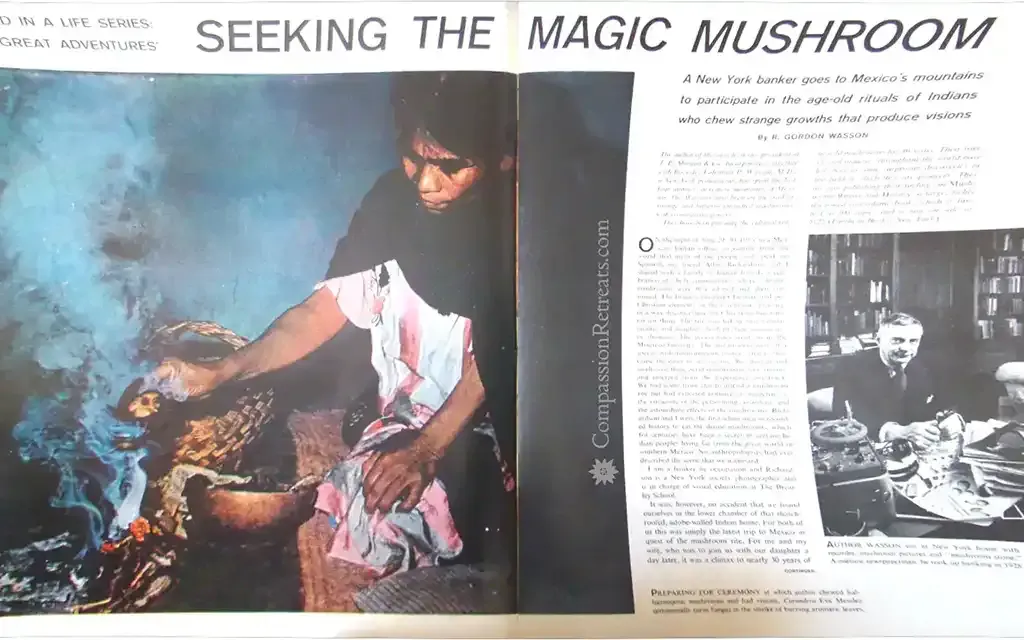
Wasson, who was deeply affected by the experience, decided he had to share it with the world. Even though he supposedly promised María Sabina that they'd keep the secret, he published a detailed, first-person story, "Seeking the Magic Mushroom," in LIFE magazine's May 13, 1957 issue. The article, which included photos by Richardson and mushroom drawings by botanist Roger Heim, described the ritual, Wasson's visionary time, and the deep Mazatec respect for the fungi ("They carry you there where God is"). A LIFE editor even added the catchy title, making "magic mushroom" popular, even against Wasson's wishes.

The effect was instant and huge. Wasson's gripping story introduced psilocybin mushrooms to a massive Western audience, changing them from a niche ethnobotanical curiosity into a cultural phenomenon. The article sparked intense curiosity, inspiring a generation of researchers (including young Harvard psychologist Timothy Leary), artists, writers, spiritual seekers, and counterculture figures to explore these substances. It effectively kicked off the modern psychedelic era in public awareness.
But, this sudden exposure really devastated María Sabina and her community. Huautla de Jiménez was flooded with foreigners—hippies, seekers, adventurers—who all demanded access to the sacred mushrooms. This rush disrupted village life, turned the velada into a commodity, and profaned it, and it brought in drug abuse that wasn't connected to the traditional use. María Sabina, blamed for revealing the secret, faced being shut out, accusations of selling the tradition, and personal heartbreak, including her house being burned. Both Wasson and Sabina later regretted the publication and what happened afterward. The Wasson/Sabina encounter is a really moving, cautionary story about how media narratives work and the huge ethical responsibilities involved in cross-cultural meetings that involve sacred knowledge, setting up debates today about cultural appropriation in the psychedelic world.
Sources for this article
- Magic Mushrooms: A History | Chelsea Green Publishing
- TEONANACATL: THE NARCOTIC MUSHROOM OF THE AZTECS2 - ResearchGate
- Huautla, hippies and hongos - The History of Emotions Blog
- Seeking the Magic Mushroom - Wikipedia
- Mazatec Shamanic Knowledge and Psilocybin Mushrooms - Chacruna
- The Impact of a 1957 LIFE Magazine Article on the Psychedelic Movement
- Sacred Stewardship: The Mesoamerican Mushroom Ceremony
- Ethical Concerns about Psilocybin Intellectual Property - PMC
Explore meaningful journeys grounded in respect and safety, Spiritual & psilocybin retreats in Tulum