No. Classical Tantra is a spiritual tradition aimed at liberation and most of its practice is meditation and breathwork. Sexual practice sits at its edges if it appears at all. The association comes from neo-Tantra, a 20th-century Western movement that puts sexuality at the centre. Compassion Retreats teaches the classical material, and all touch in sessions is non-sexual, inside boundaries the guest sets first.
This is part of our writing on Tantra and intimacy.
Is Tantra the same as the Kama Sutra?
No. The Kama Sutra is a guide to pleasure written around the 3rd century CE and its subject is the art of living well. Classical Tantra is a path aimed at liberation, with texts written from the 6th century onwards. Different centuries and different goals.
Both come from India and both touch the subject of sex, which is where the confusion starts. Vatsyayana's Kama Sutra treats kama, which means desire and pleasure, as a proper goal of life and gives it full attention. It is a book about enjoying life and it never pretends otherwise.
Tantra answers a different question. Its texts aim at moksha, at liberation, and where sexuality appears in them at all it appears as one energy among several, worked toward that aim rather than toward pleasure. Most of the technique is meditation and mantra. The Kama Sutra is about enjoying life. Classical Tantra is about being free inside it.

Where does the association come from?
European writing in the colonial period read Tantra through its own stories about forbidden ritual. Later Western publishing kept the sexual material because that is what sold. What travelled was the selection rather than the tradition.
Most people reach this subject through a search for sex. We understand. The question deserves a straight answer rather than a sales page.
Complex systems lose their edges when they cross cultures, and Tantra crossed several at once. Its texts are deliberately symbolic in places and its ritual material was easy to read as exotic from the outside. Add a market for the sexual bits and the picture sets itself. The origins of the tradition are set out in What is Tantra, really?.
What is neo-Tantra?
Neo-Tantra is a 20th-century Western movement that takes the name and mixes it with New Age thinking and with modern Western views of sex. Osho, earlier known as Bhagwan Shree Rajneesh, did much to popularise it. It is not the classical tradition.
It centres on sexual technique and on pleasure and intimacy work. Some of its teachers keep a serious discipline and some do not. The classical material it borrows arrives without the rules that the classical material carried.
Classical Tantra asks for long practice under a teacher inside a lineage. Neo-Tantra is largely self-directed and picked up at workshops and from books. Classical work rests on texts and on ritual in fixed forms. Neo-Tantra simplifies those or replaces them with newly made exercises.
The label tells you little. The schedule and the person holding it tell you more. If you are comparing offers, How to choose a Tantra retreat sets out the questions to ask.
What happens in a Tantra session at Compassion Retreats?
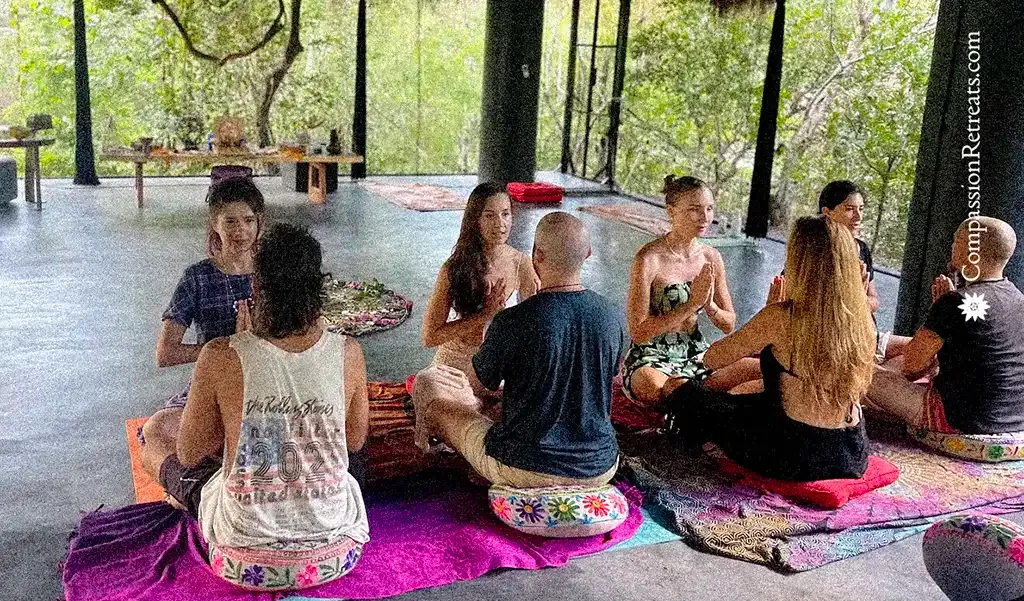
At Compassion Retreats a Tantra session works through the body and the breath. Nothing sexual happens in it. All touch is non-sexual, inside boundaries you set first, and any of it can be declined without explanation.
Compassion Retreats holds one party at a time in a private house outside Tulum, so there are no strangers in the house. The day runs with slow movement and breathing and meditation and some mantra. Nothing is performed and nothing is assumed.
The boundary is not a compromise with the tradition. Classical Tantra is not sexual practice and Compassion Retreats does not treat it as one. If sexual technique is the part you wanted, this is not the house for it.
The facts
| Classical Tantra | Neo-Tantra | |
|---|---|---|
| When it appears | India, with texts from the 6th century CE | The 20th-century West |
| Aim | Liberation and self-realisation | Personal growth and relationship work |
| Role of sexuality | One energy among several | Often the central subject |
| Teacher and lineage | A guru inside a lineage, with initiation | Often self-directed, from workshops and books |
| Texts and ritual | The Tantras and the Agamas, ritual in fixed forms | Modern exercises and selective borrowings |
| Setting | Lineages and ashrams | Workshops and courses |
Where this work happens
The Couples Intimacy and Tantra retreat runs 4 or 5 days for two people alone in the house. It works with contact and attention and keeps all touch non-sexual.
For one person the Solo Tantra retreat runs 4 days inside the same boundaries.
Sources
- What Is Tantra? A Guide to Understanding This Sacred Tradition - Ma Ananda Sarita
- Unlocking the Mysteries of Tantra: Exploring Tantric Practices - Quinta Carvalhas - The Green Farm
- Tantra: Philosophy, Rituals, and Magic - Journal of Sanātana Dharma
- Tantra - Sahajayana
- Neotantra - Wikipedia
- Demystifying Tantric sex | British Museum
- Tantric Sex Positions: What Are They? - WebMD
- The 5 Busting Myths about Tantra: A Comprehensive Guide
- Tantra Misconceptions - AUM Tantra Yoga
The rest of this material sits in the Tantra and intimacy hub.