Transpersonal psychology is the branch of psychology that takes the spiritual and transcendent parts of human experience seriously. The field counts four forces in psychology: behaviourism, psychoanalysis, humanistic psychology and transpersonal psychology. The first journal of the new field appeared in 1969. Compassion Retreats builds its work on this framework and screens every guest on a call before confirming a booking.
This is part of our writing on psilocybin and psychedelic work.
Where do its ideas come from?
William James studied mystical experience in 1902 in The Varieties of Religious Experience and Carl Jung wrote about the collective unconscious and the archetypes. The field itself formed at the end of the 1960s, when Abraham Maslow judged that humanistic psychology had left the spiritual side out. It needed a name and a journal and it got both.

Maslow wrote about the farther reaches of human nature, the territory beyond getting one's life in order. The decade around him was full of Eastern philosophy and of psychedelic research. The name came out of his circle and gave the new journal its title in 1969.
The field then built itself an address. The Association for Transpersonal Psychology was founded in 1972 and the California Institute of Transpersonal Psychology opened in 1975, now Sofia University. The ideas had somewhere to live.
What does it add to psychology?
It treats non-ordinary states as meaningful rather than as symptoms. States that the standard models treat as symptoms belong inside the account of a person instead. Meditation gets read that way and so does a psychedelic session.

Maslow called the everyday version of these states peak experiences and took them seriously as data. James had done the same in 1902 with religious experience. The practical difference is where a person can put what happened to them. A strange night in meditation has somewhere to go in this framework and nowhere to go in most of the others.
The material is physical as much as it is philosophical. The jaw tightens. The breath changes. A map that ignores the body is not much use.
Who built the modern practice?
Grof supplies the map of non-ordinary states. Wilber supplies the largest framework, and Assagioli supplies the method people actually practise. All three are taught inside transpersonal training today.
Stanislav Grof. His map comes from thousands of supervised LSD sessions before those studies were closed. He sorted the material that surfaces in sessions into layers. The first is biographical, the memories and conflicts of a life. Under it sits the perinatal layer, which he mapped as four basic matrices (BPM I to BPM IV). Above both sits the transpersonal realm, where people report meeting archetypal figures and living through what feels like ancestral memory. When LSD research stopped, Grof and his wife Christina built Holotropic Breathwork, which reaches for the same states through accelerated breathing and music.
Ken Wilber. His integral model tries to hold every valid account of reality in one frame. The core of it is AQAL, a framework for viewing reality from four angles and across levels, lines, states and types of development. The four angles are the inner life of a person, the outer behaviour of a person, the shared culture of a group and the systems the group runs. Levels are stages of development and each one transcends and includes the one before it.
Roberto Assagioli. He was an Italian psychiatrist in contact with Freud and Jung and he built psychosynthesis in the 1910s and 1920s because he judged psychoanalysis had left too much out. His egg diagram maps the psyche with a lower unconscious and a middle unconscious and, above the conscious self, a higher unconscious he called the superconscious. He argued that people suffer from repressing the sublime as much as from repressing the base.
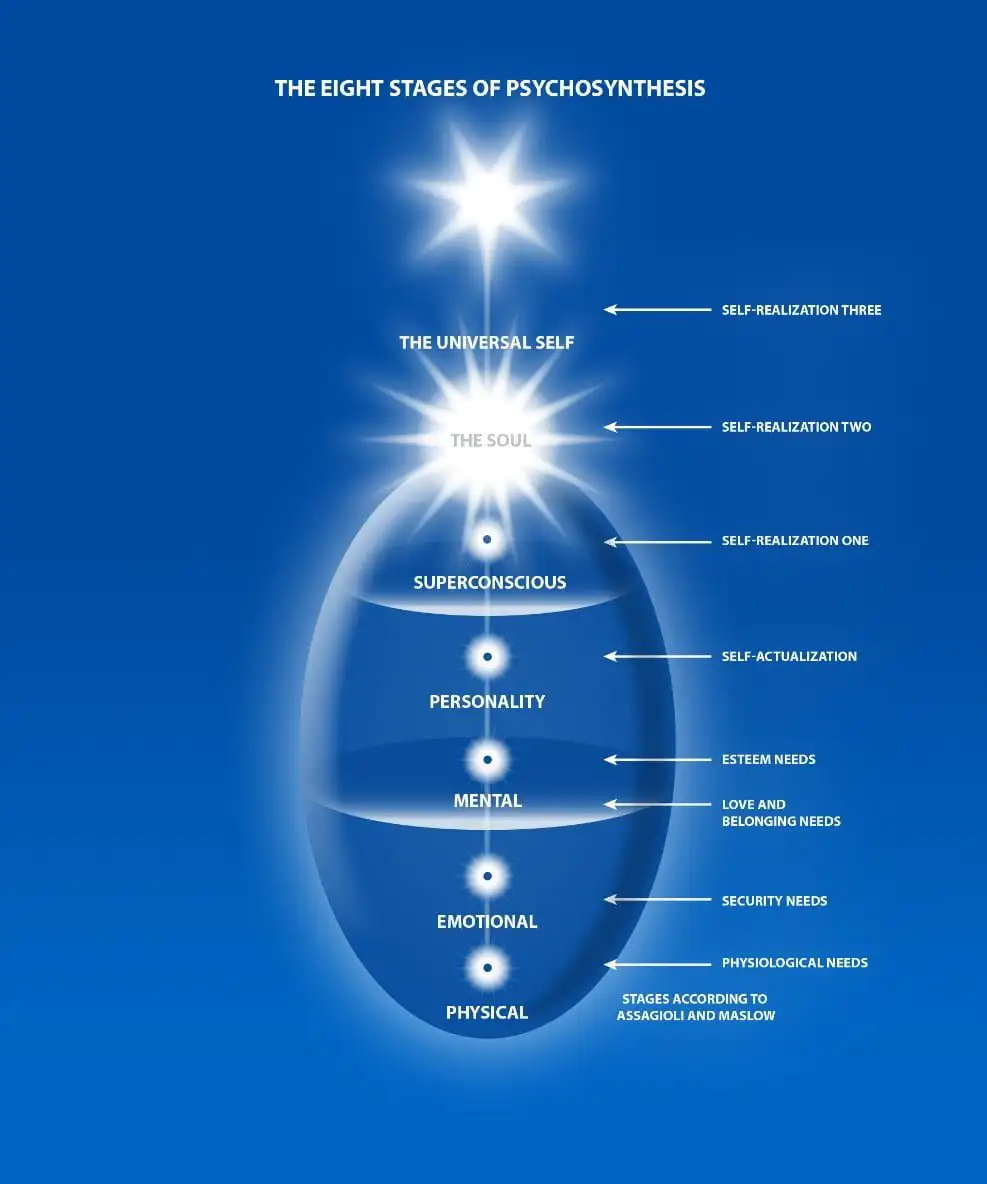
His method works with subpersonalities like the inner critic and with the will. The central practice is disidentification: watching thoughts and feelings without letting them define you. His words for it are plain. I have emotions and I am not my emotions.
What does it mean for work like ours?
The aim is wider than feeling better. It is to put the personality in order around what Assagioli called the higher self. That is the frame Compassion Retreats works inside.
The shape of the work follows the frame. Compassion Retreats puts a screening call and a confidential intake per person, covering medical and psychological background, before anything is confirmed, and gives every guest two integration calls after they go home, inside the first month.
The session day runs six to eight hours with one facilitator present from the first hour until the guest is settled at night. The medicine is optional and the days are complete without it.
Timeline
| Date | Event |
|---|---|
| 1902 | William James publishes The Varieties of Religious Experience |
| 1910s and 1920s | Roberto Assagioli develops psychosynthesis |
| 1969 | The Journal of Transpersonal Psychology appears |
| 1972 | The Association for Transpersonal Psychology is founded |
| 1975 | The California Institute of Transpersonal Psychology opens, now Sofia University |
Where this work happens
The psychedelic integration retreat is built on this frame and runs 3 to 5 days, with two integration calls after you go home.
The Silent Meditation retreat runs 3 days and is where the states this literature describes arrive without any substance at all.
Sources for this article
- What is Transpersonal Psychology? | Meridian University
- The Science Behind Flourishing: How Psychology And Spirituality Align - UEF Foundation
- Finding The Truth That Sets Us Free: challenges of spiritual work ...
- Life Coaching - Erika Trice
- Transpersonal Orientation: Psychosynthesis in the Counselor's office Introduction - Psychology Today
- The Varieties of Religious Experience by William James
- Humanistic Approach in Psychology (humanism) - Simply Psychology
- A Review of Transpersonal Theory and Its Application to the Practice ...
- Alef Trust - About Us
- Stanislav Grof - Wikipedia
- What is Holotropic Breathwork? A Complete Guide
- Integral theory (Ken Wilber) - Wikipedia
- The AQAL Model: A Brief Introduction - Integral Life
- Roberto Assagioli - Wikipedia
- Psychosynthesis - Wikipedia
- Seven Basic Constructs of Psychosynthesis
The rest of this field and the work around it sits in the psilocybin and psychedelic work hub.