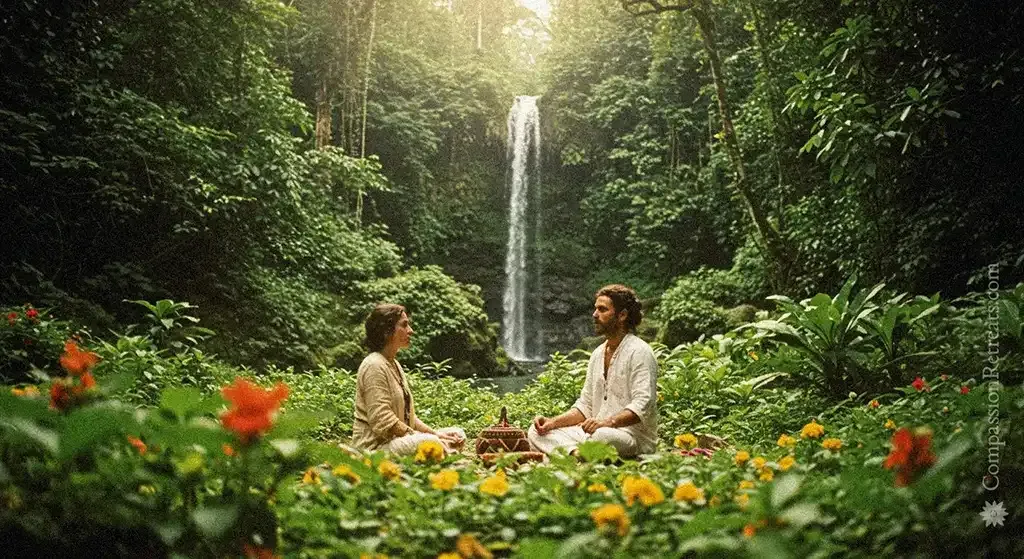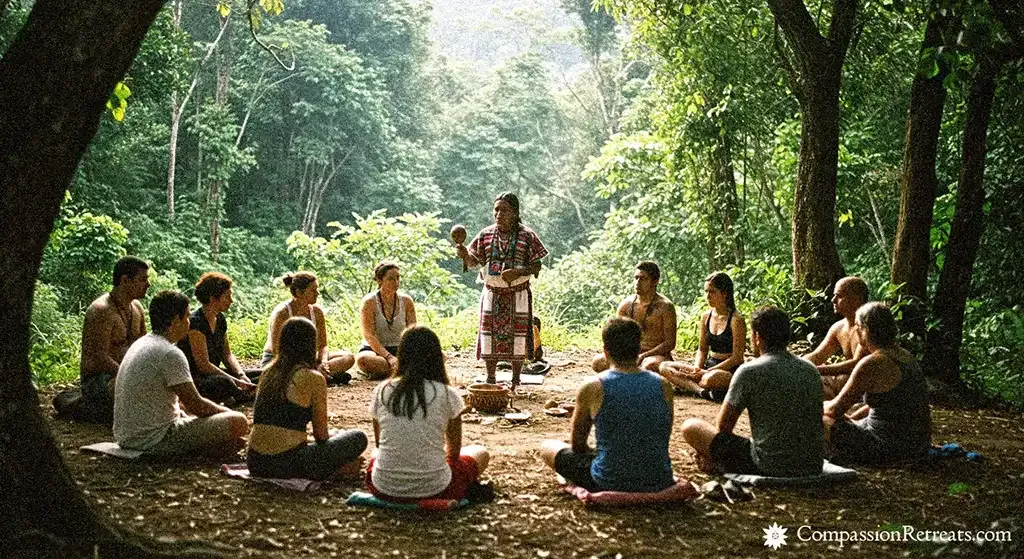
Holding space means staying present with someone through difficult hours without fixing them, steering them or judging what comes. At Compassion Retreats it has a plain shape: one facilitator stays within reach from the first hour of a session day until the guest is settled at night. The house takes one booking at a time, so nobody is holding space for four people at once.
What is holding space, and what is it not?
It is attention without agenda. The person holding the space listens to understand rather than to answer, and stays close when the hour turns hard.
It is not therapy and it is not advice. Nothing gets interpreted back at you, and nobody steers the session toward an outcome they have in mind. This is the part guests find hardest to believe until they have been through it. The work belongs to the person doing it. Ours is to keep the conditions steady while it moves.
What does it ask of the person holding it?
It asks for presence that does not waver and patience that does not hurry. It also asks for the willingness to sit through someone else's difficult hour without reaching for an easy fix.
Paul Gilbert's compassion-focused work describes why this matters. His model holds that people run on emotional systems built for threat, for pursuit and for care, and that the system for care can be underdeveloped in anyone who spent years managing on their own. Training it is deliberate work. It is what a decade or more of practice is actually for.
What does the research on compassion practice report?
Studies on compassion training programmes have reported changes in how people relate to their own distress, including reduced self-criticism. Research on psychedelic sessions has reported that the period afterwards matters as much as the session itself, which is why the work here includes two integration calls after you go home.
Say what a study reported and no more. Compassion Retreats does not claim that any practice treats any condition, and we do not diagnose. What we can say is what we do, and what guests tell us afterwards.
How does this shape a session at Compassion Retreats?
Before you arrive there is a screening call and a confidential intake for each person, and a preparation call after that. On the session day one facilitator stays within reach throughout, from the first hour until you are settled at night. Nothing is compulsory and any touch is non-sexual, inside boundaries you set first.
The screening exists so we know your history before anything is confirmed, and we will say plainly on the call if we are not the right people for what you need. What passes between us and a guest stays between us.
Where this work happens
Psychedelic integration runs the private format for one person or one party, with one facilitator staying within reach from the first hour of the session day until you are settled at night. Couples psilocybin and reconnection holds two people on the same day in the same room, inside that same steady frame around both of them.
If this is the kind of work you are looking for, start with the screening call. Nothing is confirmed before it happens, and it costs nothing. The rest of this subject sits in the psilocybin and psychedelic work hub.
Sources for this article
- Compassion-focused therapy - Wikipedia
- self-compassion.org
- What is Holding Space? - Holding Space Foundation
- The Healing Power of Holding Space - Psychology Today
- The Art of Holding Space: A Practice of Love, Liberation, and Leadership
- Bringing MDMA-assisted therapy for PTSD to traditional healthcare systems...
- What Is the State of Compassion Education? A Systematic Review...
- The therapeutic alliance between study participants and intervention...