The research on psilocybin is small and it is real. Randomised double-blind studies at Johns Hopkins and Imperial College London reported large and lasting drops in depression and anxiety after sessions given with support, and the US FDA gave psilocybin for depression a special fast-review designation. Compassion Retreats screens every guest on a call before confirming a booking.
This is part of our writing on psilocybin and psychedelic work.
Where did the modern research start?
Chemistry got there first. Arthur Heffter isolated mescaline from peyote in 1897 and Ernst Späth synthesised it in 1919. Albert Hofmann at Sandoz isolated psilocybin and psilocin from the Mexican mushrooms in 1958 and synthesised both. Pure compounds meant studies could measure doses.
The first Western wave ran through the 1950s and into the early 1960s on two tracks. One track read LSD and mescaline as psychotomimetics, drugs that produce a temporary state resembling psychosis, and used them to study schizophrenia. Work at Spring Grove State Hospital followed that model. The other track put the same compounds to use in work with alcoholism.
In Saskatchewan the psychiatrists Humphry Osmond and Abram Hoffer gave high doses of LSD and reported one-year sobriety rates of 40 to 50 percent. Bill Wilson, who founded Alcoholics Anonymous, tried LSD himself and saw room for it. By the mid-1960s over a thousand papers on LSD had appeared.

The cultural track ran beside the science. Aldous Huxley took mescaline under Osmond's supervision in 1953 and published The Doors of Perception in 1954. He argued that the compound closed the brain's reducing valve and let a wider reality through. Osmond, writing to him about the right word, coined psychedelic, which means mind-manifesting.
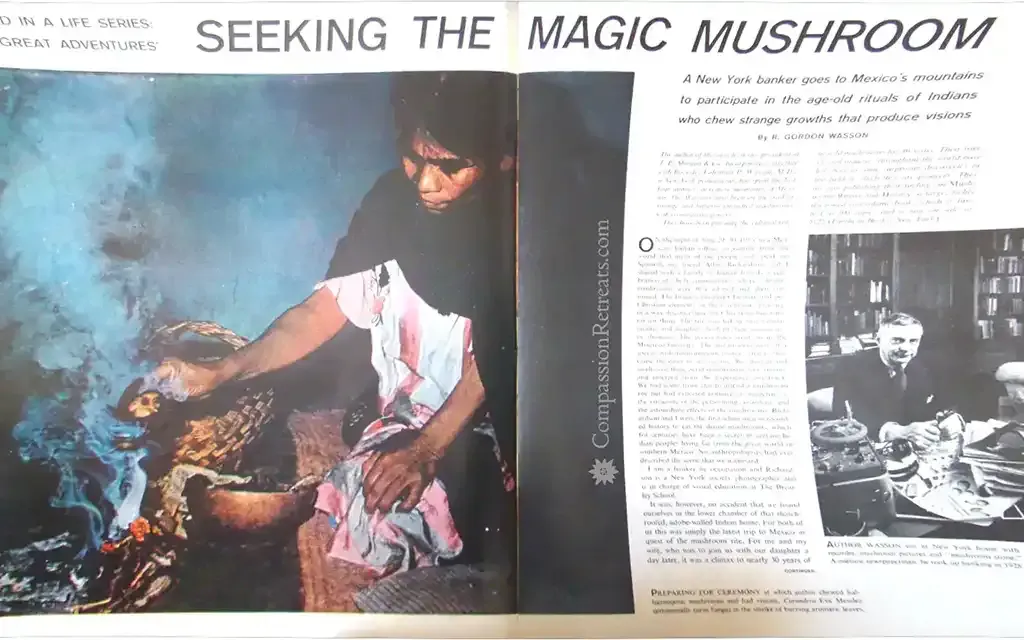
Timothy Leary read the 1957 LIFE article and ate mushrooms in Mexico in 1960. Back at Harvard he and Richard Alpert started the Harvard Psilocybin Project. The work there gave us the phrase set and setting, and it ran the Concord Prison and Marsh Chapel experiments before it ended.
Why did the research stop?
It stopped for political reasons rather than scientific ones. Leary and Alpert were dismissed from Harvard in 1963 and the counterculture took the substances with it. US states banned LSD from 1966.
The Controlled Substances Act put LSD and psilocybin in Schedule I in 1970, and the 1971 UN Convention on Psychotropic Substances carried the same controls outward. Ken Kesey and his Merry Pranksters drove their bus across the country and handed the substances out at parties called Acid Tests. The bans followed that visibility more than any reading of the research.
The studies closed and stayed closed for decades. The Saskatchewan work on alcoholism was left where it stood.
What do the modern trials report?
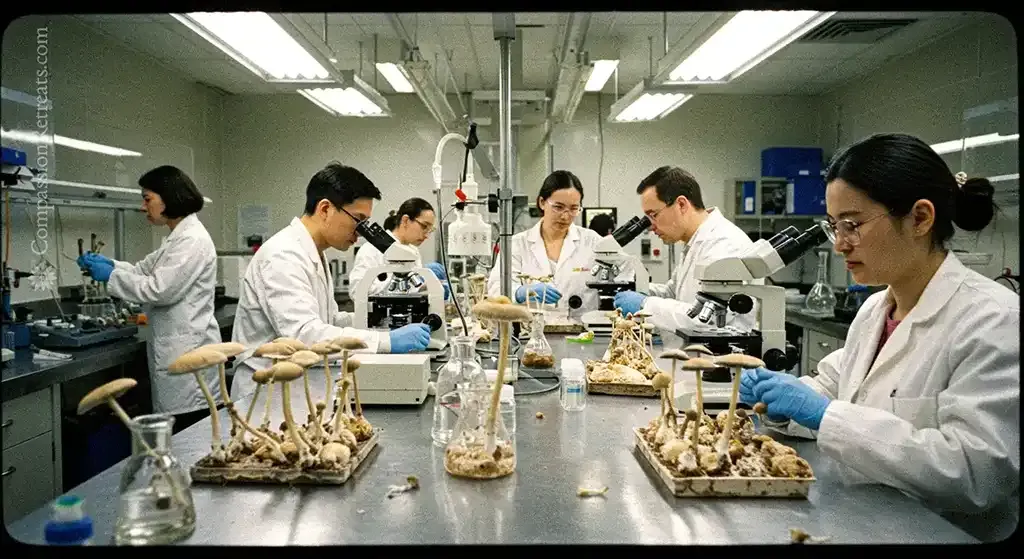
The modern wave began when Johns Hopkins and Imperial College London restarted human studies in the 2000s, starting with healthy volunteers. Randomised double-blind trials in people facing serious illness reported large drops in depression and anxiety that held at the six-month follow-up. Trials in depression point the same way.

Two randomised double-blind trials published in 2016 gave a single psilocybin session with support to people living with cancer. The study teams reported substantial and sustained decreases in depression and anxiety, and less fear of death among the participants. Most of them still showed the gains at follow-up months later. The US FDA answered with a fast-review designation, which is how the regulator marks a compound it wants studied quickly.
Pilot studies of smoking and of alcohol use report more people stopping after psilocybin sessions than the same programmes manage alone. The samples are small and the follow-up is short. Johns Hopkins runs much of this work.
MDMA belongs in the same conversation and it is a different compound. MAPS, founded in 1986, ran two Phase 3 trials, MAPP1 and MAPP2, of MDMA sessions for post-traumatic stress. Between 67 and 71 percent of the MDMA group no longer met the study criteria for the condition when the trials ended.

In 2024 an FDA advisory committee questioned the design of those trials and the fact that participants could tell which arm of the study they were in. The work is not finished.
How do researchers think it works?
Two ideas carry most of the explanation. Imaging studies report that psilocybin lowers the integrity of the default mode network, the systems behind self-referential thought. The REBUS model proposes that the brain loosens its deepest assumptions for the hours a session runs.
Other work looks at neuroplasticity and at the brain building new connections between neurons. None of this is settled. The trials share a shape: preparation before the session and support through it. The 1960s name for that shape is set and setting.
What does the research not say?
The trials are small and they do not run long. Most involve a few dozen participants and follow them for months rather than years, and every one of them screens out people with a personal or family history of psychosis. What the studies report is what they report.
No trial says psilocybin works for everyone. Read the results as early and keep the numbers in view.
Timeline
| Date | Event |
|---|---|
| 1897 | Arthur Heffter isolates mescaline from peyote |
| 1919 | Ernst Späth synthesises mescaline |
| 1954 | Aldous Huxley publishes The Doors of Perception |
| 1958 | Albert Hofmann isolates and synthesises psilocybin and psilocin |
| 1963 | Leary and Alpert are dismissed from Harvard |
| 1970 | The US Controlled Substances Act places psilocybin in Schedule I |
| 1971 | The UN Convention on Psychotropic Substances extends the controls |
| 2006 | Johns Hopkins begins its modern psilocybin studies |
| 2016 | Randomised trials report sustained drops in depression and anxiety in people with cancer |
| 2024 | An FDA advisory committee questions the design of the MDMA trials |
Where this work happens
The research keeps returning to what happens after the session. Compassion Retreats includes two integration calls in every booking, inside the first month after you go home, and the psychedelic integration retreat runs 3 to 5 days around the optional session.
For readers who arrived here through exhaustion rather than curiosity, the Nervous System Reset retreat runs 3 to 5 days and the days are complete without any substance.
Sources for this article
- MDMA and MDMA - Assisted Therapy | American Journal of Psychiatry
- Psychedelics Research and Psilocybin Therapy - Johns Hopkins Medicine
- Psilocybin produces substantial and sustained decreases in depression and anxiety in patients with life - threatening cancer: A randomized double - blind trial - PMC
- Psilocybin for the Treatment of Depression: A Promising New Pharmacotherapy Approach - PMC - PubMed Central
- Psychedelics and health behaviour change - PMC - PubMed Central
- Psychedelics, the Law and Politics - UC Berkeley BCSP
- Teonanácatl and Ololiuqui, two ancient magic drugs of Mexico - unodc
- Spring Grove Experiment - Wikipedia
- Humphry Osmond - PMC
- Psychedelic therapy in the treatment of addiction: the past, present and future - Frontiers
- Aldous Huxley's The Doors of Perception - UQ eSpace
- The Impact of a 1957 LIFE Magazine Article on the Psychedelic Movement
- Timothy Leary - Wikipedia
- Cultural History of LSD: Turn On, Tune In, Drop Out - Science | HowStuffWorks
- Acid Dreams: The Complete Social History of LSD: The CIA, the Sixties, and Beyond
- A Brief History of Magic Mushrooms in BC - Vancouver Mycological Society
- Peyote and Diabolism in New Spain - Early Modern History in 28 Objects
The rest of this work sits in the psilocybin and psychedelic work hub.